March 15, 1978
PART 1
The Representative, Leduc, Alberta, March 15, 1978*
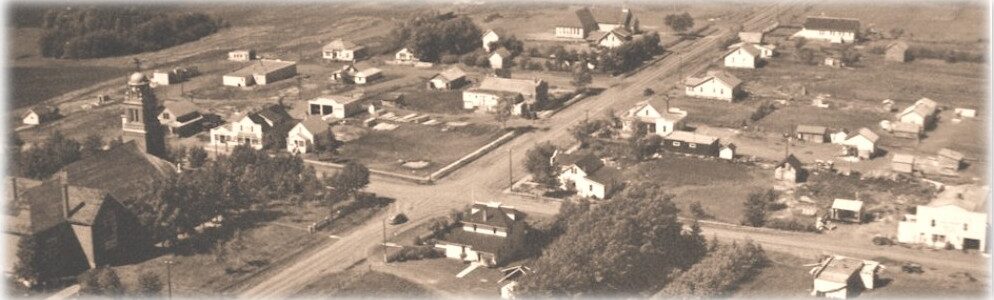
Beaumont – An Historical Illustration
By Barbara Willis
[NOTE: French translation follows]
Page 24
The following is the first in a [four] part series on the history of Beaumont.
Resource material has been compiled from La Survivance June 17, 1942 issue, History of the
Catholic Church in Central Alberta and most importantly from the memories of the longtime
residents of Beaumont.
Louise Goudreau contributed valuable notes from her class project on the village and Mrs.
Annette Gobeil provided a sensitive translation of French material.
It is essential to understand the powerful and all pervasive influence of the church in the
establishment and growth of small communities such as Beaumont. The church was the very
reason for the village’s existence, for without the church first, the district would perhaps have
remained scattered farms with little or no community core. The church provided comfort,
reassurance, strength, and hope to remain optimistic.
As well as spiritual leadership, the parish priest very often comprised the only village ties with
literacy and education. Many people could not read or write and the priest performed a valuable
communication link with the outside world.
Beaumont was the church and the church Beaumont for as long as people needed the security
and protection offered in an otherwise fierce and hard-fought struggle to create a life in the
frontier of western Canada.
***
Perhaps it was because the rolling hills and little lakes and park-like nature of the land reminded
them of their native provinces of Ontario and Quebec. Whatever the reasons, the first settlers to
the Leduc district chose the Beaumont and Clearwater areas first for their new homes in the
west.
With the coming of the railroad, families from Quebec, Minnesota and North Dakota settled in
what is now the Beaumont area. In the very early 1890’s, the Chartier, Dumont and Brunelle
families came to the district followed shortly thereafter by the Bolducs, Morins, Juneaus,
Dubords, Lachapelles, Lamberts, Fouquettes, Onettes, Gagnons, Charests, Royers, Goudreaus
and Bérubés. By the spring of 1893, the new settlement had built up to over 20 families. The
district was then known as Sandy Lake.
For many years, life in these small communities revolved around the church. The people relied
to a great extent on the priest for his leadership and guidance. The parish of Beaumont, situated
15 miles south east of south Edmonton and ten miles north of Leduc, had none of the
advantages of special conditions which attract settlers, such as railroads or coal mines. But
rather, the community owes its existence to the fertility of the land and to the church built shortly
after the arrival of the first settlers.
Land for homesteading was sold for $10 in the area. Life was hard with few or no amenities for
those early settlers. At first, mass was celebrated by Father Perreault from the Mission of Stony
Plain, in private homes, usually in the Louis Chartier residence. In 1894, the community was
visited by Father Lacombe who came to console and encourage the newcomers to this land.
By the fall of 1893, the need for a school was felt. The French and English of the district built a
public Catholic Elementary school which they named “Fouquette” in the spring of 1894 on Mr.
Johnson’s land. The first teacher was Mlle. J. Haydon.
That same spring, the community applied to Bishop Grandin of St. Albert to form their own
parish. The bishop purchased ten acres of land on a section belonging to the Hudson’s Bay
Company for $50. Father Lacombe chose the site on which to build the church. Mr. Chartier
made a gift of 20 acres more land for the church grounds. These 30 acres were the foundation
of the village of Beaumont.
In the fall of 1894, Father Poitras was sent by Father Grandin as the parish’s first pastor. His
immediate task was to build the church and rectory.
Construction was completed in the spring of 1895. In gratitude, the parish chose as its patron
saint, St. Vital after the venerable bishop St. Albert, Monseigneur Vital Grandin.
However, soon after, difficulties arose. Some of the parishioners wished to change the site of
the church while others wanted it to remain as built. The Church decreed that it should remain in
its original location. The first High Mass was celebrated in the new church on June 30, 1895.
At this time, the settlement underwent a change of name. A group of English settlers who lived a
short distance from the church wanted to retain the name of Sandy Lake and this request was
granted. But to commemorate the beautiful location of the Catholic parish on the ridge of a hill,
the village was named Beaumont (meaning beautiful hill). The name of Beaumont was
suggested it is said, by John Royer, one of the settlers.
Now that the church was built, items for divine worship were installed. A bell weighing 800
pounds was brought from Montreal for $100. The chalice, cruets, censer and alter linen were
furnished by Bishop Grandin. He took up a collection to buy the sacred vestments, stations of
the cross, etc. Lastly, many parishioners contributed articles to aid in the decoration of the
church sanctuary.
In July 1885, a petition was sent to the government asking for weekly postal service from
Edmonton to the Sandy Lake district. Two months later, Mr. Ludger Gagnon was named
postmaster. The mail was brought into Ellerslie every Friday and delivered from there to
Beaumont.
In the spring of 1886, Reverend Father Beauparlant of Montreal came to Beaumont and took
charge of the parish. He lived in the Chartier residence during the construction of a rectory
which took most of the summer to complete. The small presbytery was constructed of hewn logs
and only 20 feet square.
Beaumont was gradually growing. By June 1897, the people were pleased to learn that their
postal service would be established on a bi-weekly basis.
New settlers were moving in but some were also returning to their places of origin. Life was full
of hardships. Land has to be broken, crops were sometimes poor and markets for produce were
just opening, so money was very scarce. Father Beauparlant was one to succumb to the hard
life. He left Beaumont in December 1897.
As Father Beauparlant had been postmaster, the post office was then moved to the Edmond
Bonin residence and Mrs. Bonin became postmistress.
In September 1898, Father A. Ethier became rector of the parish. He was to be the first priest to
really make his influence felt in the community. The year 1898 was a good year for the settler
both in terms of weather and crops, and in terms of the growth of the community spiritually, with
the arrival of Father Ethier, and materially, with increases in population and services. The two
districts, Sandy Lake and Beaumont, now supported some 45 French families and 30 English
speaking families. The French families owned in total about 70 quarter sections of farm land.
The fall of 1899 saw the erection of a few buildings close to the church. This was the start of the
village as such. Mr. J.E. Lavigne, who in August 1898 opened a store in his house, built a store
on the north east side of
Pg. 25
the church. Prior to this, a small trading post had been maintained by Henry Lampon a mile or
so from where the village was finally located. One of Mr. Lavigne’s daughters opened a
boutique near the store. Mr. Fred Long opened a blacksmith’s shop close by. Mr. Francois
Vallee, upon retirement, had a house built in the village. These buildings, along with the church,
rectory, post office and the store and the Gagnon, Lavigne and Chartier homes, made up the
village of Beaumont.
In 1899, a group of 38 farmers formed an incorporated company called Compagnie de Moulins
de Beaumont, Limitee (Harvest Company of Beaumont Limited). At the end of September 1899,
new machinery was in full use and the co-operative results after five weeks of work was $600
profit.
Thus, Beaumont moved into the 20th century firmly established as a community with an active
commercial base and social and spiritual life revolving around the church.
(To be continued)
FRENCH
Pg. 24 The Representative, Leduc, Alberta, 15 mars 1978
Beaumont – une illustration historique
Par Barbara Willis
Ce qui suit est le premier volet d’une série en [quatre] parties sur l’histoire de Beaumont.
Les ressources utilisées proviennent du numéro du 17 juin 1942 de La Survivance, de l’ouvrage History of the Catholic Church in Central Alberta et, surtout, des souvenirs des résidents de longue date de Beaumont.
Louise Goudreau a apporté une contribution précieuse en fournissant des notes tirées de son projet scolaire sur le village, et Mme Annette Gobeil a fourni une traduction fidèle des documents en français.
Il est essentiel de comprendre l’influence puissante et omniprésente de l’Église dans la création et la croissance de petites communautés telles que Beaumont. L’Église était la raison même de l’existence du village, car sans elle, le district serait peut-être resté un ensemble de fermes dispersées, sans véritable noyau communautaire. L’Église apportait réconfort, assurance, force et espoir pour rester optimiste.
Outre son rôle de guide spirituel, le curé de la paroisse était très souvent le seul lien du village avec l’alphabétisation et l’éducation. Beaucoup de gens ne savaient ni lire ni écrire et le curé jouait un rôle précieux de liaison avec le monde extérieur.
Beaumont était l’église et l’église était Beaumont tant que les gens avaient besoin de la sécurité et de la protection offertes dans une lutte autrement féroce et acharnée pour se créer une vie à la frontière de l’Ouest canadien.
***
C’était peut-être parce que les collines ondulantes, les petits lacs et la nature semblable à un parc leur rappelaient leurs provinces natales, l’Ontario et le Québec. Quelles qu’en soient les raisons, les premiers colons du district de Leduc ont choisi les régions de Beaumont et de Clearwater pour s’installer dans l’Ouest.
Avec l’arrivée du chemin de fer, des familles du Québec, du Minnesota et du Dakota du Nord se sont installées dans ce qui est aujourd’hui la région de Beaumont. Au tout début des années 1890, les familles Chartier, Dumont et Brunelle s’installèrent dans le district, suivies peu après par les Bolduc, Morin, Juneau, Dubord, Lachapelle, Lambert, Fouquette, Onette, Gagnon, Charest, Royer, Goudreau et Bérubé. Au printemps 1893, la nouvelle colonie comptait plus de 20 familles. Le district était alors connu sous le nom de Sandy Lake.
Pendant de nombreuses années, la vie dans ces petites communautés tournait autour de l’église. Les gens comptaient dans une large mesure sur le prêtre pour son leadership et ses conseils. La paroisse de Beaumont, située à 24 km au sud-est d’Edmonton et à 16 km au nord de Leduc, ne bénéficiait d’aucun des avantages susceptibles d’attirer les colons, tels que les chemins de fer ou les mines de charbon. La communauté doit plutôt son existence à la fertilité de la terre et à l’église construite peu après l’arrivée des premiers colons.
Les terres destinées à la colonisation étaient vendues 10 dollars dans la région. La vie était dure pour ces premiers colons, qui disposaient de peu ou pas de commodités. Au début, la messe était célébrée par le père Perreault, de la mission de Stony Plain, dans des maisons privées, généralement chez Louis Chartier. En 1894, la communauté reçut la visite du père Lacombe, venu consoler et encourager les nouveaux arrivants sur ces terres.
À l’automne 1893, le besoin d’une école se fit sentir. Les francophones et les anglophones du district construisirent une école primaire catholique publique qu’ils baptisèrent « Fouquette » au printemps 1894 sur le terrain de M. Johnson. La première enseignante fut Mlle J. Haydon.
Au printemps de la même année, la communauté a demandé à Mgr Grandin, évêque de St. Albert, de créer sa propre paroisse. L’évêque a acheté dix acres de terrain appartenant à la Compagnie de la Baie d’Hudson pour 50 $. Le père Lacombe a choisi l’emplacement où serait construite l’église. M. Chartier a fait don de 20 acres supplémentaires pour le terrain de l’église. Ces 30 acres ont constitué la base du village de Beaumont.
À l’automne 1894, le père Poitras fut envoyé par le père Grandin comme premier curé de la paroisse. Sa tâche immédiate était de construire l’église et le presbytère.
La construction fut achevée au printemps 1895. En signe de gratitude, la paroisse choisit comme saint patron Saint-Vital, en l’honneur du vénérable évêque de Saint-Albert, Monseigneur Vital Grandin.
Cependant, peu après, des difficultés sont apparues. Certains paroissiens souhaitaient changer l’emplacement de l’église, tandis que d’autres voulaient qu’elle reste telle qu’elle avait été construite. L’Église a décrété qu’elle devait rester à son emplacement d’origine. La première grand-messe a été célébrée dans la nouvelle église le 30 juin 1895.
À cette époque, la colonie changea de nom. Un groupe de colons anglais qui vivaient à proximité de l’église souhaitaient conserver le nom de Sandy Lake, et leur demande fut acceptée. Mais pour commémorer l’emplacement magnifique de la paroisse catholique sur la crête d’une colline, le village fut baptisé Beaumont (qui signifie « belle colline »). Le nom de Beaumont aurait été suggéré par John Royer, l’un des colons.
Une fois l’église construite, les objets nécessaires au culte divin ont été installés. Une cloche pesant 800 livres a été apportée de Montréal pour 100 $. Le calice, les burettes, l’encensoir et le linge d’autel ont été fournis par Mgr Grandin. Il a organisé une collecte pour acheter les vêtements sacrés, les stations du chemin de croix, etc. Enfin, de nombreux paroissiens ont fait don d’objets pour aider à la décoration du sanctuaire de l’église.
En juillet 1885, une pétition a été envoyée au gouvernement pour demander un service postal hebdomadaire entre Edmonton et le district de Sandy Lake. Deux mois plus tard, M. Ludger Gagnon a été nommé maître de poste. Le courrier était acheminé à Ellerslie tous les vendredis, puis livré à Beaumont.
Au printemps 1886, le révérend père Beauparlant, de Montréal, est venu à Beaumont et a pris la direction de la paroisse. Il a vécu dans la résidence Chartier pendant la construction du presbytère, qui a pris presque tout l’été. Le petit presbytère était construit en rondins taillés et ne mesurait que 20 pieds carrés.
Beaumont grandissait progressivement. En juin 1897, les habitants furent ravis d’apprendre que leur service postal serait établi deux fois par semaine.
De nouveaux colons s’installaient, mais certains retournaient également dans leur lieu d’origine. La vie était pleine de difficultés. Il fallait défricher la terre, les récoltes étaient parfois maigres et les marchés pour les produits agricoles commençaient tout juste à s’ouvrir, de sorte que l’argent était très rare. Le père Beauparlant fut l’un de ceux qui succombèrent à la dureté de la vie. Il quitta Beaumont en décembre 1897.
Comme le père Beauparlant était maître de poste, le bureau de poste fut alors transféré à la résidence d’Edmond Bonin et Mme Bonin devint maîtresse de poste.
En septembre 1898, le père A. Ethier devint recteur de la paroisse. Il fut le premier prêtre à exercer une réelle influence sur la communauté. L’année 1898 fut une bonne année pour les colons, tant sur le plan climatique et agricole que sur le plan spirituel, avec l’arrivée du père Ethier, et sur le plan matériel, avec l’augmentation de la population et des services. Les deux districts, Sandy Lake et Beaumont, comptaient désormais quelque 45 familles francophones et 30 familles anglophones. Les familles francophones possédaient au total environ 70 quarts de section de terres agricoles.
À l’automne 1899, quelques bâtiments ont été construits près de l’église. Ce fut le début du village tel qu’on le connaît aujourd’hui. M. J.E. Lavigne, qui avait ouvert un magasin dans sa maison en août 1898, a construit un magasin au nord-est de l’église.
Pg. 25
Auparavant, Henry Lampon tenait un petit comptoir commercial à environ un kilomètre et demi de l’emplacement final du village. L’une des filles de M. Lavigne a ouvert une boutique près du magasin. M. Fred Long a ouvert une forge à proximité. M. François Vallée, à sa retraite, s’est fait construire une maison dans le village. Ces bâtiments, ainsi que l’église, le presbytère, le bureau de poste, le magasin et les maisons des Gagnon, Lavigne et Chartier, constituaient le village de Beaumont.
En 1899, un groupe de 38 agriculteurs a formé une société constituée en personne morale appelée Compagnie de Moulins de Beaumont, Limitée (Harvest Company of Beaumont Limited). À la fin du mois de septembre 1899, les nouvelles machines tournaient à plein régime et, après cinq semaines de travail, la coopérative affichait un bénéfice de 600 $.
C’est ainsi que Beaumont est entré dans le XXe siècle, solidement établi en tant que communauté dotée d’une base commerciale active et d’une vie sociale et spirituelle centrée sur l’église.
(À suivre)